
Sometimes you have to move backwards to move forward
Before every workshop, I ask participants to rate how confident they feel using AI on a scale of 1 to 5. The answers usually land around 3.5 or 4. People have tried the tools, found a few things they’re good for, and feel reasonably comfortable with them.
I sometimes joke that I’ll have done my job properly if, by the end of the first session, they’d reappraise their confidence to a 2. This probably seems like a strange pitch for a fledgling AI training business. For the right reasons, a drop in that number is good news. For the wrong reasons, it just means I’ve confused everyone.
Same skills, bigger scale
Say someone arrives at a 4 because they use AI to draft emails and summarise meeting notes, and they’re good at it. By the end of the session, they rate themselves a 2. Their email drafting hasn’t got any worse. In fact, if I’ve done my job, they should be drafting even better emails. Ask how confident they feel about that task alone, and they’d probably still say 4, if not higher.
What’s changed is what a 5 represents. When they walked in, a 5 meant being very good at the tasks they already used AI for. Since then, they’ve watched the same tools, prompted in much the same plain-English way they already use, investigate a spreadsheet and build a small tool for a job they do every week. That’s work they’d never have thought of bringing to AI, and it didn’t need a technical background, just a better sense of what to ask for.
It’s a bit like rating yourself 4 out of 5 at cooking, then spending an afternoon in a professional kitchen. Your omelettes aren’t any worse. You just have a greater appreciation of what else a kitchen can do.

Still a perfectly good omelette.
Most people only see the familiar uses
Writing tasks are where most people start. In Gallup’s survey of US workers from May 2026, writing and editing was the most common use of AI at work, at 51% of AI users. Data analytics came in at 18% and process automation at 16%.
Those figures say nothing about how well people use AI, and a writing task can involve plenty of judgement. They do show that some uses are far more familiar than others. The less familiar uses also came out ahead on productivity: 77% of people using AI for process automation said it had improved their productivity, compared with 68% for writing and editing. Gallup notes that people who already see value in AI may be the ones finding more uses for it, so I wouldn’t read too much into the gap.
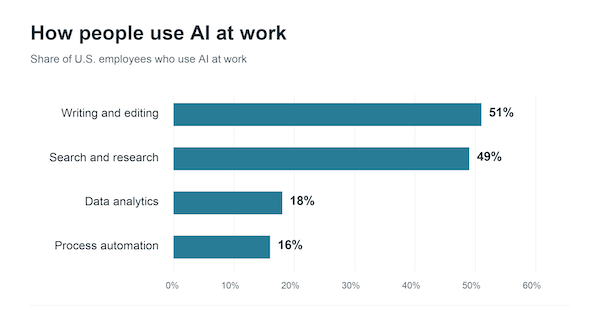
Writing is where most people use AI. The less familiar uses are far less common.
Source: Gallup, May 2026.
This makes training harder than it sounds. People can tell me where they already use AI, but nobody asks for help with a capability they don’t know exists. I saw the same thing when I worked in financial services, automating spreadsheets. Most of my colleagues used Excel as a ledger, a grid for typing in numbers and adding them up. They had no idea that formulas, macros, and pivot tables could do much of the work they were doing by hand, so they never thought to ask.
A large part of my job, then and now, is helping people sort their work into three groups: tasks AI can handle directly, tasks better solved by an automation that AI helps them build (such as a formula or macro that runs the same way every time), and tasks that should stay with a person. That last group gets less attention than it deserves.
There’s more depth in the familiar tasks too
Going further doesn’t have to mean building a multi-agent graph. Take the meeting summary. Paste in a transcript, ask for a summary, and you’ll get a tidy page of bullet points in which someone’s passing thought about a rebrand carries the same weight as the actual budget decision.
Ask it instead to separate decisions from suggestions, list the actions, and flag anything where nobody agreed an owner or a deadline. It also needs to know what the meeting is for and who’s in the room. For a weekly meeting, typing that out every time would get old fast, but ChatGPT and Claude can both hold that background in a project folder, so the AI already knows it before you paste anything in. What comes back is much closer to what a good minute-taker would produce.
Email works the same way: a draft improves a lot when the AI can see the earlier correspondence and knows what the message needs to achieve. The task has the same name, but the result is far more useful.
Keeping the next step manageable
A long tour of impressive capabilities can leave people more overwhelmed than inspired, so I start small. Participants try an approach on a manageable task, look closely at what comes back, and work out what needs improving, with me on hand for questions.
Then we get more ambitious. For someone who works with spreadsheets, that might mean describing a repetitive problem, giving the AI the rules and a few examples, and building a solution they test on a copy of the data first. (Testing on the original is a lesson most people only need once.) For someone who writes briefings, it might mean working across several documents and checking that every important claim traces back to a source.
Part of that progress is learning AI’s limits: where it needs more context, where its answer needs checking, and when a simpler approach would do the job better. Sometimes the best solution turns out to be a formula you already knew.
Something to try today
Pick a task you do every week that you’ve never thought of as an AI job, such as reconciling two lists or reformatting a report that always arrives in a mess. Describe it to your AI tool in plain English: what you start with, what you need at the end, and where it tends to go wrong. Then ask how it could help.
Leave out anything confidential or personal. A made-up example with the same structure works just as well. You might get a useful idea, or a confident answer that doesn’t quite work. Either way, you’ll have a better sense of how far the scale goes.
What I want confidence to mean
A lower score on its own wouldn’t tell me a workshop had worked. What matters is what people can do afterwards: spot a useful opportunity, give the tool what it needs, judge the result, and push past the first answer instead of accepting it. Confidence built on those skills is where the value of AI starts to show, even if it starts at a 2. The response I’m hoping for is something like: “I hadn’t realised I could use it for that. I know where I want to start.”
Most teams I work with are using AI for a fraction of what it could do for them, usually without realising it. If you’d like help finding your team’s next step, I run practical AI workshops for non-technical teams across Ireland. Book a free 20-minute call, and we’ll work out where to start.