
What the research says about Irish businesses and AI skills
When I set up Tributary, I had two main motivations. The first was to build on the AI training I’d done in my last few years at News UK & Ireland, where I’d seen what these tools could do for people in a wide variety of roles. The second was a hunch that there were hundreds of Irish SMEs either unsure where to start with AI or using only a fraction of what it can do.
If I’m honest, that hunch was based entirely on anecdotes. Fortunately, the Enterprise Allowance process forced the issue. It requires a detailed business plan, and “vibes” is not an accepted form of market research. So I went looking for evidence. There’s plenty of it, and almost all of it backs up my assumptions. Where it doesn’t, I’ll say so.
Most businesses use AI, but few have gone past the basics
The first part of my hunch was that most businesses were only scratching the surface. The Small Firms Association surveys its members on AI every year, and its August 2026 results are a useful reality check. Of the 404 small businesses surveyed, only 18% had built AI into some or most of their business. Among the firms using AI, 92% relied on generic tools like ChatGPT and Microsoft Copilot, mostly for admin and marketing content, and only 7% used AI tools they'd developed themselves.
There's nothing wrong with using ChatGPT to write a social post. But I see the same pattern in almost every workshop I run: people who use AI daily for emails and have never thought to hand it a spreadsheet or a pile of customer feedback. The tools can do far more than most people ask of them, and usually nobody has shown them how.
Skills are the barrier businesses name most often
When Digital Business Ireland asked 140 Irish companies what was holding back their AI adoption, 68% said a lack of skills and training, more than any other barrier. Employees say much the same thing. In Ibec's 2025 survey of 800 workers, 81% said extra training would help them use AI better, and 27% had never had any formal AI training at all.
So employers think their people lack the skills, and their people would like some training, please. You'd think this would be easy to sort out.
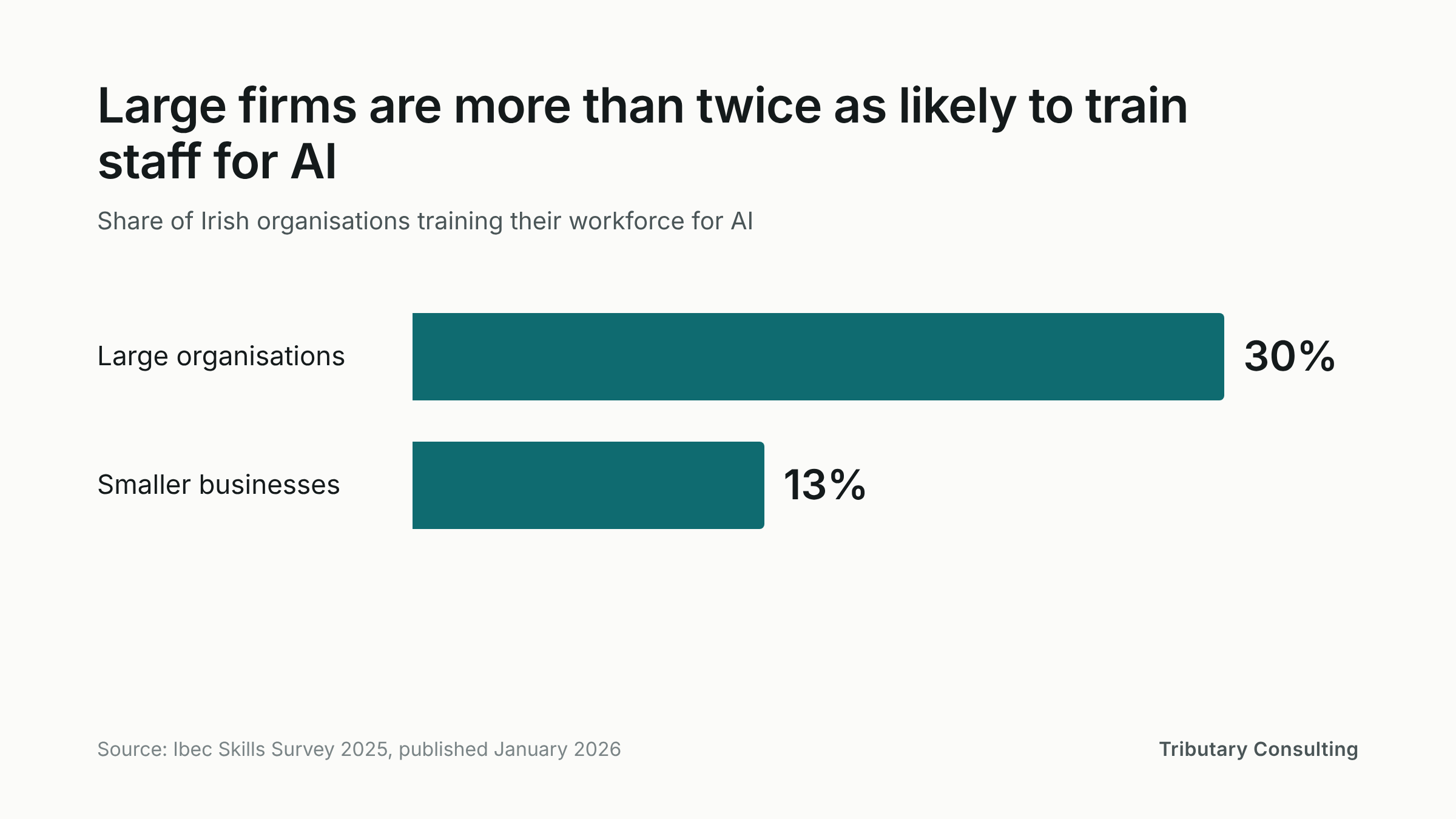
Large firms are more than twice as likely to train staff for AI.
The smallest businesses are training least
It isn't, especially for smaller firms. Ibec's 2025 Skills Survey found large organisations were more than twice as likely to be training staff for AI as smaller ones: 30% compared with 13%. Ibec's explanation rings true. Small firms spend their limited training budgets on compliance and day-to-day operations first, and AI waits its turn.
That's a pity, because small teams arguably have the most to gain. A business with eight staff that saves each of them an hour a week has found a full day's work without hiring anyone.
In the meantime, staff are left to work it out for themselves. In Accenture's research across Ireland and the UK, 47% of employees said they were expected to use new technology without adequate training. Some fill the gap by finding their own tools, which brings risks of its own (I wrote about that in my post on shadow AI).
Does training actually make a difference?
This is where the evidence gets thinner, and where I should be careful, because I sell AI training and would quite like the answer to be yes.
The most quoted evidence comes from KPMG's Global AI Pulse, a survey of 2,110 senior executives in 20 countries in early 2026. Organisations confident in their talent pipeline were nearly four times as likely to report meaningful value from AI: 77% compared with 20%. That's a big gap, but it comes with two caveats. Three quarters of the respondents worked for companies with revenue over $1 billion, which is not most Irish businesses. And it shows a link, not a cause. Companies that invest in their people probably do plenty of other things well too.
My own evidence is smaller and closer to home. Over my last two years at News UK & Ireland I trained more than 200 colleagues, and regular AI use across the Ireland and Scotland teams rose from 19% to 74%. I can't claim all of that for the training. The tools improved enormously over the same period, and some people would have got there on their own. The change I noticed most was harder to measure. At first, people used the tools in a very prescriptive way, sticking closely to the tasks we'd covered, and that carried on even after the early workshops. As the training developed, I put more emphasis on trying new approaches and on coming to me when they weren't sure. Over time, people got more curious, trying the tools on their own work and asking whether AI could help with things we'd never discussed.
So the evidence that businesses lack AI skills, and that staff want training, is strong and consistent. The evidence that training on its own produces better results is encouraging but not proven, and I'd be suspicious of anyone who tells you otherwise.
Where to start with a small budget
Digital Business Ireland also found that 65% of businesses planned to invest in AI in 2026, and 60% of those expected to spend €10,000 or less. With budgets that size, every euro has to earn its keep, so it's worth knowing where AI would actually help before spending any of it. Happily, finding out costs nothing but an hour.
Ask everyone on your team to write down the task that ate the most time last week and that they'd happily never do again. Pick one that's repetitive and low-risk, sit down with the person who does it, and spend an hour seeing whether AI can help. Some attempts will work and some won't, but you'll learn more about what your team needs than any survey can tell you, including the ones above.
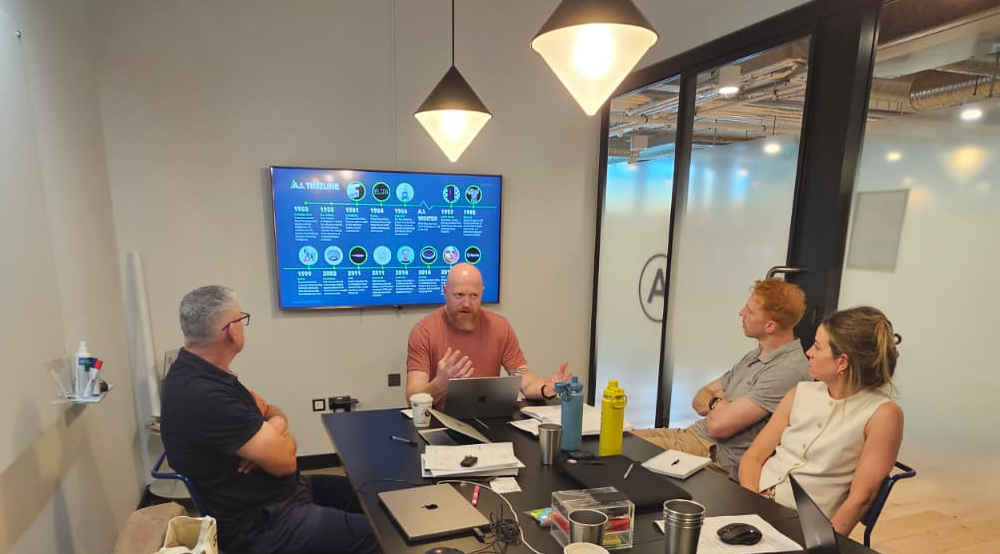
An AI workshop with the Zambrero Ireland team, July 2026.
The tools are the easy part
As with most technology, buying the tools is only part of the job. The real value comes from investing in the people who use them.
One last lesson from News UK & Ireland. I worked on dozens of AI projects there, and plenty of them didn’t work. This is probably the most clichéd sentence I’ll write (if I ever top it, assume AI wrote it), but I learned more from those failures than from the projects that went smoothly. A big part of my training is that AI isn’t a cure-all. It’s a really useful tool when it’s used well, but one of the most common mistakes I see is people throwing ChatGPT and its cousins at every problem. Knowing when to use it is as much a skill as knowing how.
If you’d like help building those skills in your team, I run practical AI workshops for non-technical teams across Ireland. Let’s set up a call and work out where to start.